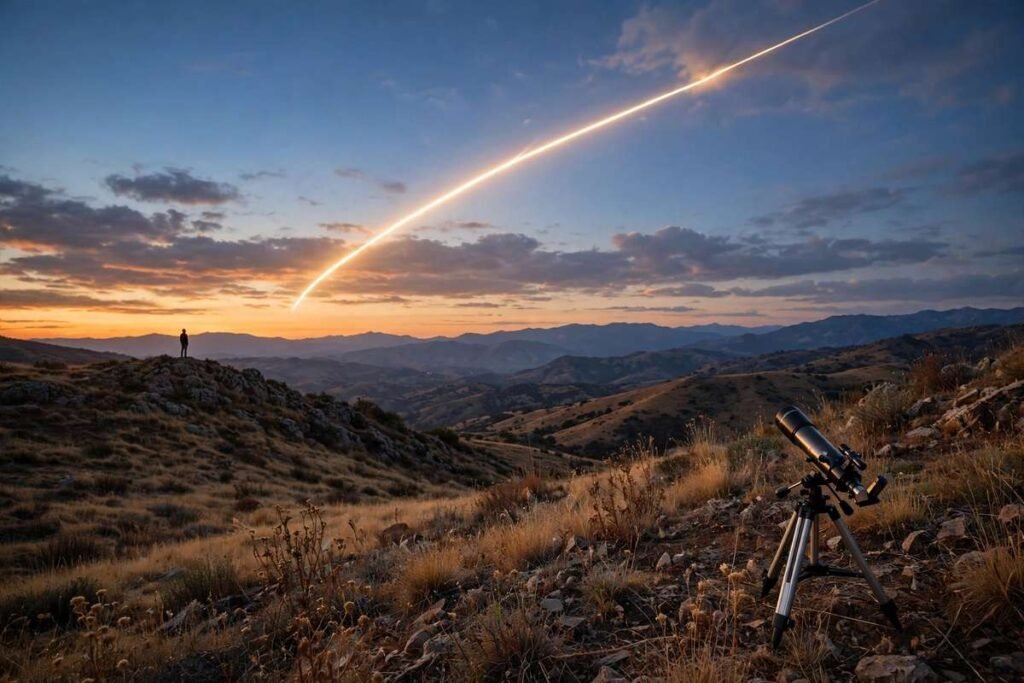
The International Space Station passes over your town far more often than you might think. The honest answer to the question is that no single time works for everyone, because the station is moving fast and your own spot on Earth is turning underneath it. What you can do, in about two minutes, is find the exact next pass for your own street.
This guide explains the method step by step, so you can answer the question for tonight, wherever you live. It also covers why the good passes cluster around dawn and dusk, and why most of the station’s trips over your home happen without you ever seeing a thing.
The Short Answer First
The station completes one orbit of Earth in about 90 minutes, at an altitude of roughly 400 km, which is about 250 miles. That means it circles the planet about 16 times every day, and its path regularly carries it over or near your location. The catch is visibility, not distance.
You can only spot the station when it is lit by the Sun while your own sky is dark enough to give it contrast. That combination happens in the hours around sunrise and sunset. So the practical answer has two parts: the station will pass over you soon, but the next pass you can actually see is the one worth planning for, and a sighting tool will name it down to the minute.
How to Find the Next Pass for Your Location
NASA runs a free service called Spot the Station, and it is the easiest place to start. The official Spot the Station page from NASA explains how the sighting system works, and the matching app is available for phones and tablets in most countries. You set your preferred location once, and the app does the orbital maths for you.
On the homepage you will find a Next Sighting(s) List, which shows every viewing opportunity coming up for your location. Each entry gives you the date and the start time in your own local time zone. Pick the soonest entry, or scroll for one with a high maximum height if you want the most impressive view.
Each sighting comes with a few details worth understanding before you step outside. Appears tells you the compass direction and angle where the station will first show itself. Maximum height is how high it will climb, measured in degrees, with the horizon at 0 and the point directly overhead at 90. Disappears tells you where it will leave your view, and the visible time tells you how many minutes you have.
Turn on notifications and the app will alert you before a visible pass, with the date, time and duration filled in. NASA only sends alerts for passes you can genuinely see, not for every time the station crosses your sky. Other well known tracking websites and apps work in the same way, and any of them is fine as long as it uses your real location rather than a rough guess.
Why the Good Passes Happen Near Dawn and Dusk
The station has no bright light of its own that you could see from the ground. It shines because sunlight reflects off its structure and solar panels, in much the same way the Moon shines. NASA notes that it is not bright enough to pick out against a blue daytime sky, so daylight passes are effectively invisible even when the station is right overhead.
Deep in the night the opposite problem appears. With the Sun far below your horizon, the station often flies through the shadow of the Earth and goes dark itself. There is nothing for your eyes to catch, even on a perfectly clear night.
Dawn and dusk solve both problems at once. You are standing in darkness, or near it, while 400 km above you the station is still bathed in full sunlight. That contrast is why every sighting opportunity falls within a few hours before or after sunrise or sunset, and why your best chances come in clusters at one end of the day or the other.
The Orbit Behind Those Times
The station travels at about 17,500 mph, fast enough to cross your whole sky in minutes. Because an orbit takes only about 90 minutes, the crew on board see around 16 sunrises and 16 sunsets in a single day. From the ground, that speed is exactly why sightings are short and why being outside at the right minute matters so much.
Earth keeps rotating while the station flies, so the ground track of each new orbit sits further west than the one before, by roughly 23 degrees of longitude per orbit. This is why pass times slide around from day to day instead of repeating neatly. You might get a run of lovely evening passes for several days, then a quiet spell, then a week of early morning ones.
The orbit is also tilted by 51.6 degrees to the equator. Places between about 51.6 degrees north and 51.6 degrees south get the station passing close to overhead. If you live beyond that band, in Alaska or northern Canada for example, the station will never pass directly over you, and it will always appear lower toward the horizon. The station spends its life in low Earth orbit, and our guide to how high satellites orbit shows how that layer compares with the homes of GPS and weather satellites.
Why Not Every Orbit Is Visible
Start with about 16 orbits a day, then apply the filters. Only a handful of those orbits pass close enough to your location to matter at all. Of that handful, the daylight ones are washed out by the bright sky, and many of the night time ones pass through the shadow of the Earth, where the station reflects no sunlight toward you.
What survives is a small set of dawn and dusk passes, and even those vary in quality. A pass that peaks below about 10 degrees sits in haze and behind rooftops and trees for most people. A pass on the far side of your sky is dimmer and easier to lose. NASA points out that, depending on the geometry, viewing opportunities for one location can range from several times a week in a good stretch to about once a month in a poor one, and clouds can cancel any of them without asking.
How Bright It Gets, and How Long a Pass Lasts
When conditions line up, the station is the third brightest object in the sky, behind only the Sun and the Moon. Good passes are rated by sighting charts at around magnitude minus 3, which makes the station brighter than any star and easy to follow with the naked eye. It looks like a steady white light gliding in a straight line, with no flashing lights, and it never changes direction, which is the quickest way to separate it from an aircraft.
A typical sighting lasts a few minutes from appearance to disappearance. A high pass that crosses near the top of your sky can stay in view for six minutes or more, while a low graze along the horizon may be gone in under two. Do not be surprised if the light switches off suddenly part way across the sky. That is the station sliding into the shadow of the Earth, and it is one of the most satisfying parts of the show.
Tips for Your First Sighting
Pick a pass with a maximum height of 40 degrees or more, and be outside a few minutes early so your eyes can settle. Note the appears direction from the listing, and face that way with as open a view as you can find. A fist held at arm’s length covers roughly 10 degrees of sky, which is a handy way to picture the angles the listing gives you.
Keep your phone in your pocket once the minute arrives, because its bright screen will spoil your night vision. The station appears on schedule, often faint and low at first, then brightening as it climbs. If you miss one, do not worry. The list always holds another chance within a few days.
Frequently Asked Questions
Can I see the ISS with my bare eyes, or do I need a telescope?
Your bare eyes are enough, and they are actually the best tool for the job. The station moves too fast for most telescopes to follow comfortably. It appears as a bright, steady, fast moving light, brighter than any star on a good pass, and binoculars are optional rather than necessary.
How often does the ISS pass over my house?
The station orbits about every 90 minutes, so it crosses your region many times each day. Visible passes are much rarer, because the light has to be right. Depending on your location and the season, expect anything from several good sightings in a week to a gap of a few weeks with none worth watching.
Why did the station vanish in the middle of the sky?
It flew into the shadow of the Earth. The station shines only while sunlight is striking it, and when it crosses into shadow the reflected light cuts off in a second or two. A sudden disappearance high in the sky is normal, and it means the pass was a dusk one ending exactly as predicted.
What maximum height should I look for in a sighting listing?
Maximum height is measured in degrees above the horizon, with 90 degrees meaning directly overhead. Passes reaching 40 degrees or higher are bright, long and easy to find. Passes below about 20 degrees are shorter and can hide behind buildings, trees and haze, so treat them as a bonus rather than your main plan.
Leave a Reply