The Short Answer
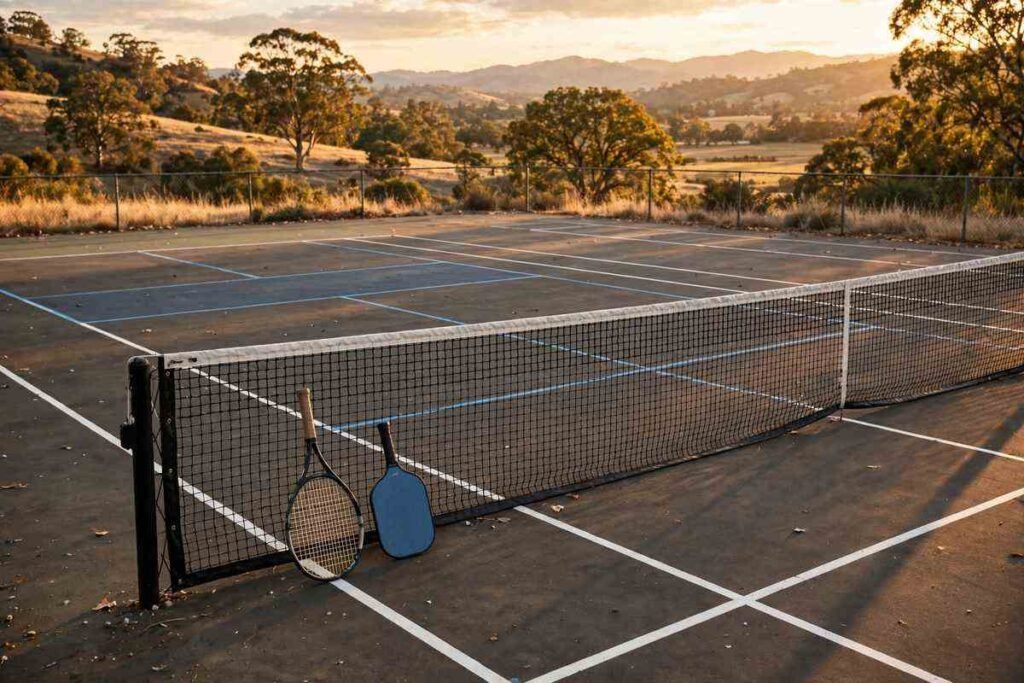
Yes, you can rally, drill, and play a friendly shortened game of tennis on a pickleball court. Plenty of people do exactly that at parks and multi sport courts every week.
What you cannot play there is real, full format tennis. The pickleball court is far smaller than a tennis court, and that size gap changes almost every shot in the game, from the serve to the baseline rally.
So the practical answer is this. A pickleball court works well for a warm up, for coaching beginners, and for casual hitting with a softer ball. For a proper match, you still need a tennis court.
How the Two Courts Compare in Size
A regulation pickleball court measures 20 feet wide by 44 feet long, and the size stays the same for singles and doubles. Those figures come straight from the USA Pickleball court construction guidance, which also sets the non volley zone, known as the kitchen, at 7 feet from the net on each side.
A tennis court is a different scale entirely. It runs 78 feet long, with a width of 27 feet for singles and 36 feet for doubles. The lined pickleball court covers 880 square feet, while a lined tennis doubles court covers 2,808 square feet, more than three times as much playing area.
The gap that matters most is the length. In tennis, each baseline sits 39 feet from the net. On a pickleball court, each baseline sits only 22 feet from the net, so the whole game is squeezed into a little over half the distance.
| Measurement | Pickleball court | Tennis court |
|---|---|---|
| Length, baseline to baseline | 44 feet | 78 feet |
| Width | 20 feet | 27 feet singles, 36 feet doubles |
| Net height at the center | 34 inches | 36 inches |
| Net height at the posts or sidelines | 36 inches | 42 inches |
| Lined playing area | 880 square feet | 2,808 square feet for doubles |
There is one more catch, and it is easy to miss. Even the space around the lines is smaller. USA Pickleball calls for a minimum total playing surface of 30 by 60 feet around the 20 by 44 foot court, which leaves about 8 feet behind each baseline. A tennis player defending deep balls is used to far more room to run back into.
The Net Is a Smaller Problem Than You Think
The nets are surprisingly close. A pickleball net stands 36 inches high at the sidelines and dips to 34 inches at the center. A tennis net stands 42 inches at the posts and 36 inches at the center, so the real difference at the middle of the court is just 2 inches.
That small gap means net clearance is not what ruins tennis on a pickleball court. A groundstroke that clears a tennis net by a comfortable margin will usually clear a pickleball net too, and many players find the slightly lower tape a touch more forgiving on passing shots.
The bigger net issue is length. A pickleball net is built for a 20 foot wide court, so it simply does not stretch across a tennis width playing area. If you widen the game to use more of the slab, balls pass around the net posts instead of over the net.
What Tennis Feels Like on a Pickleball Court
The serve changes first. In tennis you serve from 39 feet behind the net into a service box that ends 21 feet past it. On a pickleball court the server stands just 22 feet from the net, so the ball reaches the returner much sooner and a full pace serve can feel almost unfair at close range.
Most players adjust without thinking about it. They take speed off the serve, add more spin, or switch to a low compression ball, the kind used for junior tennis lessons. With a standard ball at full power, honest rallies tend to break down before they really start.
Baseline play feels cramped in a different way. From 22 feet, a normal groundstroke swing sends the ball long, because the far baseline is 34 feet closer than your body expects. Players who try it usually end up shortening their swings, hitting flatter, and aiming well inside the lines just to keep the ball in play.
The angles disappear too. A tennis singles court is 27 feet wide and a doubles court is 36 feet wide, which is what makes sharp cross court shots and wide serves possible. At 20 feet wide, the pickleball court chops those angles off, so the game turns into a straight ahead hitting contest with very little court to open up.
Doubles is the tightest squeeze of all. Four tennis players on a 20 foot wide court have about half the width they are used to, and lobs become risky because there is so little depth behind the baseline. As a light doubles rally it can be fun. As a competitive match it quickly feels like a different sport.
How Blended and Shared Courts Actually Work
Many of the courts where this question comes up are not pure pickleball courts at all. Parks and clubs often paint two sets of lines on one slab, a setup usually called blended lines. Tennis lines stay in the main color, often white, and the second sport gets lines in a softer shade that players can spot without confusing the two games.
The USTA supports this shared approach for public sites with only one or two tennis courts, because it keeps both sports playable on limited land. In practice, most blended courts start life as tennis courts with pickleball lines added across them, since one tennis slab can hold two pickleball courts side by side with portable nets.
The reverse setup, tennis lines blended onto a pickleball slab, is much rarer, and the reason is simple math. A full tennis court is 78 feet long, and even the recommended pickleball playing surface of 34 by 64 feet cannot contain it. What fits instead is a shortened tennis layout, which is fine for rally games and lessons but is not a regulation court.
If your local court has both sets of lines, the etiquette is easy. Play to the lines of the game you are actually playing, call them honestly, and ignore the other color. Most confusion lasts about one game, and then your eyes learn to filter the extra paint out.
The Reverse Question Works Much Better
Playing pickleball on a tennis court is the common direction, and it works well. The tennis slab has more than enough room, so players add temporary or painted pickleball lines, roll out a portable net, and shrink the playing area to true pickleball size inside the bigger court.
If a fixed tennis net is used instead, loosening the center strap drops the middle by the needed 2 inches, down to the 34 inch pickleball height. It is not perfect at the sidelines, but for casual games it plays close to regulation.
This contrast tells the whole story. Shrinking a big court down for a smaller game is easy, because the space is already there. Stretching a small court up for a bigger game is impossible, because no paint can add the missing 34 feet of length.
Who This Setup Suits, and Who Should Skip It
Tennis on a pickleball court suits a few groups nicely. Beginners get a shorter distance to cover and a ball that comes back more often. Coaches like it for footwork drills, reaction volleys, and controlled rally games where the small court forces clean contact.
It also suits a relaxed family hit. With a low compression ball, younger players can sustain rallies on the small court that would fall apart on a full tennis court, and nobody spends the session chasing balls into the next court.
Serious players should skip it for match play. Your serve timing, your depth judgment, and your spacing all adapt to the small court within a single session, and those habits then need unlearning back on a real court. Treat it as a fun variation and a training tool, never as a substitute for the real thing.
Frequently Asked Questions
Can you play a real tennis match on a pickleball court?
Not a regulation one. A tennis court is 78 feet long and a pickleball court is 44 feet long, so the serve, the service boxes, and baseline depth cannot follow the official rules. You can play a shortened rally game to an agreed score, and many people enjoy it, but it counts as a variation rather than a true tennis match.
Is the pickleball net too low for tennis?
Only slightly. A pickleball net is 34 inches at the center against 36 inches for a tennis net, a difference of just 2 inches, so most shots clear it with room to spare. The real limitation is the net length, because a pickleball net is built for a 20 foot wide court and does not span a tennis width area.
How much smaller is a pickleball court than a tennis court?
A lot. The pickleball court is 20 by 44 feet, which is 880 square feet of lined area. A tennis doubles court is 36 by 78 feet, which is 2,808 square feet, so the tennis court offers more than three times the playing area, plus wider run back space behind the baselines.
Can you play pickleball on a tennis court instead?
Yes, and this is the direction most parks and clubs choose. Pickleball lines are added to the tennis slab as painted or taped blended lines, a portable net is set at pickleball height, and up to two pickleball courts can run across one tennis court. The tennis game stays fully playable whenever the pickleball nets are rolled away.



Leave a Reply