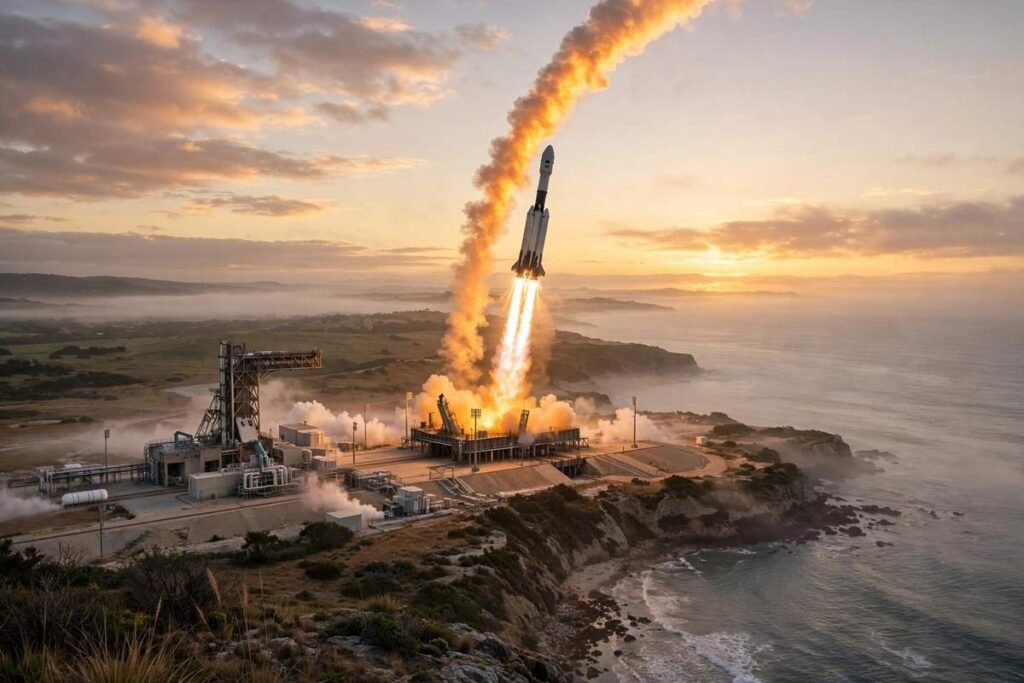
Every satellite circling Earth today began its life on the ground, folded inside the nose of a rocket. So how are satellites launched, exactly? The short version: a rocket lifts the satellite through the atmosphere, tips over until it is flying almost horizontally, accelerates to about 28,000 km/h, and then lets go. At that speed the satellite keeps falling around Earth instead of falling back to it, and that endless fall is what an orbit is.
A longer version is interesting. A launch is a carefully staged ten-minute trip where the rocket throws away most of itself, gradually and one by one, until only the satellite remains. Here is how it unfolds.
Step One: A Rocket Big Enough for the Job
Satellites cannot reach space on their own, so they ride on launch vehicles, which is the formal name for rockets built to carry cargo. The satellite sits at the very top, protected inside a two piece shell called a fairing that shields it from the noise, vibration, and rushing air of the climb.
Different satellites need different rockets. The busiest launch provider today is SpaceX, whose Falcon 9 carries everything from internet satellites to cargo bound for the space station. United Launch Alliance flies the Atlas V and Vulcan rockets in the United States, Europe flies the Ariane 6 from its spaceport in French Guiana, and Rocket Lab’s small Electron rocket serves lightweight satellites from New Zealand and Virginia. India, Japan, and China run their own fleets as well. The choice depends on the satellite’s weight and the orbit it needs.
Step Two: Liftoff and the Climb Through the Air
A launch begins straight up. The rocket’s first stage engines ignite, and once their thrust exceeds the vehicle’s weight, it lifts off the pad and climbs vertically to punch through the thickest part of the atmosphere as quickly as possible. Thick air means drag, and drag wastes fuel.
Within the first minute, the rocket passes the point of maximum aerodynamic pressure, the moment when the air pushes hardest against it. Then it begins a slow, graceful tilt called a gravity turn. Instead of flying straight up like a firework, the rocket leans further and further toward the horizon. This turn is the whole secret of reaching orbit. Height alone would just bring the satellite back down. Orbit demands sideways speed, and the turn is how the rocket builds it.
A typical first stage burns for around two and a half minutes. By the time it shuts down, the rocket is already more than 60 km up and traveling several times the speed of sound.
Step Three: Staging, or Throwing Away the Empty Parts
No single rocket can carry enough fuel to reach orbital speed in one piece, so launch vehicles are built in stages stacked on top of each other. When the first stage empties its tanks, it separates and falls away, and the smaller second stage engine ignites to continue the climb.
NASA’s Flight to Orbit guide describes this moment well: several minutes into the ascent, most launchers discard part of their weight, the dropped first stage continues on a ballistic flight back toward Earth, and the lighter upper stage keeps accelerating while pitching over toward the horizontal. Dropping dead weight is what makes the rest of the journey possible, because the remaining fuel no longer has to push empty tanks.
On many rockets the fairing is jettisoned a few minutes into flight as well. Once the vehicle is above the dense atmosphere, the satellite no longer needs its protective shell, and shedding it saves more weight.
Step Four: The Push Sideways to 28,000 km/h
Now the second stage does the real work of orbit. Flying almost horizontally above the atmosphere, it burns for several more minutes, steadily building speed. The target for low Earth orbit is about 28,000 km/h, roughly 7.8 km every second. NASA’s numbers show how exact this is: a circular orbit 100 miles up, about 160 km, requires a speed of 17,478 mph, and the required speed falls as the target orbit gets higher.
This is why rockets launch eastward whenever they can. Earth rotates toward the east, so a rocket lifting off from Florida already gets a free boost of roughly 1,670 km/h from the planet’s spin at the equator, and every bit of free speed means fuel saved.
When the satellite reaches the planned altitude and the exact planned speed, the second stage engine cuts off. That precise moment, placing the payload on its intended path at its intended velocity, is called orbit insertion. From here on, the satellite needs no push at all. It is in free fall around Earth, held in its path by gravity and its own momentum.
Step Five: Deployment, the Quiet Moment It All Leads To
Deployment is almost anticlimactic. Small springs or a separation ring gently push the satellite away from the rocket stage, at little more than walking pace, so the two drift apart safely. The satellite then wakes up: it unfolds its solar panels, points them at the Sun, turns its antennas toward Earth, and checks in with ground controllers for the first time.
Many launches carry more than one passenger. On rideshare missions, a single rocket may release dozens of small satellites one after another, like a bus dropping riders at a row of stops. SpaceX’s Transporter 1 rideshare mission in January 2021 set a record by deploying 143 small satellites from one Falcon 9. Each satellite is released at its planned moment so the whole fleet spreads out along the orbit instead of bunching together.
Different passengers also get off at different heights. If you are curious about the range of altitudes working satellites use, from a few hundred kilometres up to the geostationary ring, our guide on how high satellites orbit breaks it down by mission type.
What Happens to the Rocket Afterwards
The rocket’s story does not end at deployment. What happens to each piece depends on the vehicle.
SpaceX’s Falcon 9 first stage famously flies itself back, reigniting its engines to slow down and landing upright on a drone ship at sea or on a landing pad near the launch site, ready to fly again. Rocket Lab has also experimented with recovering its Electron booster. Other rockets are expendable: their spent stages fall into remote ocean areas, far from shipping lanes, and sink.
The second stage has a harder problem, because it reaches orbit alongside the satellite. Leaving it up there would add to the growing cloud of space debris, so responsible operators dispose of it. Depending on the mission, the stage fires its engine one last time to drop back into the atmosphere and burn up, or it is pushed into a quiet graveyard orbit far from working satellites. The satellite itself, years later at the end of its life, is usually handled the same way.
Where Satellites Launch From
Launch sites are chosen with geography in mind. Most sit on coastlines, so rockets fly out over open ocean and dropped stages land in water, not on towns. Florida’s Cape Canaveral and Kennedy Space Center are the best known, while Vandenberg Space Force Base in California handles launches heading south into polar orbits, which pass over the poles. Europe’s spaceport at Kourou in French Guiana sits close to the equator, where Earth’s rotational boost is greatest, and Kazakhstan’s Baikonur Cosmodrome, the oldest of them all, launched the very first satellite, Sputnik 1, in 1957.
Weather rules every one of these sites. High winds, lightning anywhere near the pad, or a storm along the flight path can scrub a launch minutes before liftoff, which is why launch windows and backup days are a normal part of every mission plan.
Frequently Asked Questions
How long does it take a rocket to reach orbit?
About 8 to 10 minutes. A typical two stage rocket lifts off, separates its first stage after roughly two and a half minutes, and its second stage cuts off at orbital speed around eight or nine minutes after launch. Deployment of the satellite follows within the hour on most missions, sometimes after a longer coast.
Why do rockets turn sideways instead of going straight up?
Because orbit is about speed, not just height. A satellite must travel about 28,000 km/h horizontally so that, as gravity pulls it toward Earth, it keeps missing the ground and circling instead. A rocket that only went straight up would run out of fuel and fall straight back down.
How many satellites can one rocket launch at once?
It depends on their size. A heavy rocket may carry one large satellite, while rideshare missions pack in many small ones. The record is 143 satellites on a single SpaceX Falcon 9 rideshare flight in January 2021, and missions carrying 30 to 100 small satellites are now routine.
Can a satellite be launched without a big rocket?
Almost always, no. Reaching orbital speed takes enormous energy, and a rocket is the only vehicle that can deliver it today. A few small satellites have been launched from rockets carried under aircraft, which gives a head start but still uses a rocket for the real climb. The satellite itself can only adjust its orbit once it is up there.

Leave a Reply